DARMAAN HOSPITAL & MEDICAL INSTITUTE
درمان ہسپتال اور میڈیکل انسٹی ٹیوٹ
Research & Publications
In a province that already carries Pakistan’s heaviest burden of maternal deaths and some of its poorest reproductive health indicators, another crisis is quietly taking shape. It does not make headlines, it does not feature in speeches, and it rarely appears in health budgets. Yet it is reshaping the lives and futures of thousands of young women in Balochistan. That crisis is Polycystic Ovary Syndrome (PCOS).
PCOS is often dismissed as a “hormonal problem” or a private gynaecological issue. In reality, it is a complex hormonal and metabolic disorder that affects periods, fertility, weight, blood sugar, and mental health. For a young woman, it can mean irregular or absent menstruation, unwanted facial hair, severe acne, hair loss, difficulty conceiving, and a constant sense of something being “wrong” with her body. For the health system, it means a future wave of diabetes, hypertension, and heart disease in women who should be in the prime of their lives.
Recent data from the Makran Division should serve as a wake-up call. A cross-sectional study conducted by me at Teaching Hospital Turbat between June 2024 and January 2025 examined 384 women aged 15–45 years from Turbat, Gwadar, and Panjgur. The results were alarming: 32.8 per cent were diagnosed with PCOS, almost one in every three women of reproductive age.
The highest burden was seen in women between 25 and 36 years, precisely the years when many are marrying, starting families, and working. Nearly half of all women who presented with reproductive complaints were ultimately found to have PCOS.
These figures are not just higher than previous reports from other provinces; they suggest that PCOS may be an unrecognised epidemic in Balochistan. International and Pakistani studies increasingly show that PCOS is common, underdiagnosed, and frequently misunderstood, especially in low-resource and conservative settings.
The Makran study offers a clear clinical picture. Women with PCOS reported irregular or missed periods, heavy bleeding, excess facial and body hair, severe acne, scalp hair thinning, and unexplained weight gain. More than half had a family history of PCOS, suggesting a strong genetic component in local communities.
Over one third were obese; many had raised waist circumference and waist-to-hip ratios—classic signs of central obesity and insulin resistance. Women who never exercised had nearly four times higher PCOS diagnosis rates than those who engaged in regular physical activity.
Laboratory findings confirmed the seriousness of the problem. Among the women diagnosed with PCOS, almost 90 per cent had elevated LH: FSH ratios, around 80 per cent had raised testosterone levels, and many showed high fasting insulin. This is the biochemical recipe for long-term trouble: type 2 diabetes, high blood pressure, heart disease, and endometrial complications on top of infertility and recurrent pregnancy loss.
A simple PCOS registry, starting from teaching hospitals and expanding outward, would allow the province to track trends, map hotspots, and plan services accordingly. Without numbers, the problem will continue to hide in plain sight
In any context, this would be disturbing. In Balochistan, it is dangerous.
Balochistan already has the highest maternal mortality ratio in the country and some of the weakest indicators for skilled birth attendance and emergency obstetric care. Pakistan as a whole is now counted among the countries with the fastest rising diabetes prevalence, with roughly one in four adults estimated to have diabetes or pre-diabetes.
PCOS sits right at the intersection of these two crises. A disorder that increases infertility, complicates pregnancy, and accelerates metabolic disease is taking hold in a population where access to safe childbirth, contraception, diagnostics, and specialists is already limited.
Yet for most women in Balochistan, PCOS remains unseen, undiagnosed, and unaddressed. Cultural stigma around menstruation and infertility means many girls learn early to stay silent about their bodies. Irregular periods or facial hair are treated as something to hide, not as medical issues that deserve attention. Women often reach hospitals only when they are unable to conceive, when bleeding becomes unbearable, or when cosmetic symptoms cause deep embarrassment.
Even then, the system is not ready. Outside a handful of urban centres, hormonal assays, pelvic ultrasound, and endocrine consultations are scarce or unaffordable. Many clinicians are overburdened and have little time to explore menstrual history, weight patterns, and family background in detail. Lifestyle counselling about diet, physical activity, and stress is rarely integrated into routine consultations.
Makran’s numbers tell us that PCOS in Balochistan is no longer a niche gynaecological issue. It is a systems problem. It demands a systems response.
First, Balochistan’s health planners must formally recognise PCOS as a provincial priority within reproductive, maternal, and adolescent health programmes. Simple screening questions and basic clinical algorithms can be integrated into existing services at district hospitals, rural health centres, and basic health units.
Second, teaching and divisional hospitals in Turbat, Gwadar, Panjgur, Khuzdar, and Quetta should establish dedicated women’s endocrine and metabolic clinics. These need not be expensive tertiary centres; even a small, well-run clinic with standardised protocols, subsidised tests, and group counselling can dramatically improve detection and management.
Third, the province must invest in awareness. Menstrual and hormonal health should be part of school and college health education. Lady Health Workers and community volunteers can help normalise conversations about irregular periods and fertility issues, especially in local languages. Young women should hear, clearly and repeatedly, that these symptoms are medical issues, not personal failures or causes for shame.
Finally, Balochistan needs data. A simple PCOS registry, starting from teaching hospitals and expanding outward, would allow the province to track trends, map hotspots, and plan services accordingly. Without numbers, the problem will continue to hide in plain sight.
PCOS is quietly rewriting the reproductive and metabolic future of Balochistan’s women. Whether the province chooses to see it and act on it will say a great deal about how seriously it takes the health and dignity of its women.
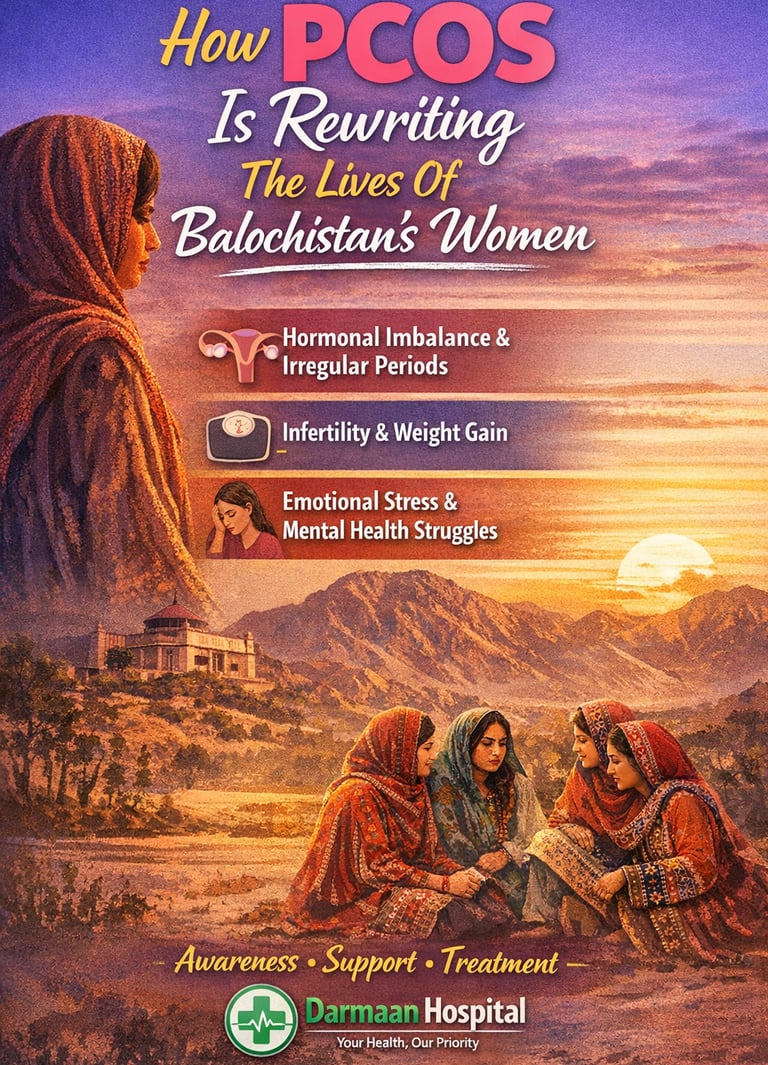
How PCOS Is Rewriting The Lives Of Balochistan’s Women
PCOS affects one in three women in Balochistan, driving infertility and metabolic disorders, and highlighting urgent gaps in healthcare and awareness
Ms. Ayesha Noor, Radiologist, Darmaan Hospital


Bridgewater Joy Residence
Co-designed by the world-renowned architect James Smith, our Bridgewater Joy residences offer top views of the nearby lake Michigan. Perfect for a small family, a professional couple, or anyone looking to set up a home office.
Pleasantview Gem Inn
Not just pleasant on the outside, our Pleasantview Gem Inn properties are especially popular among families. With underground parking and floor-to-ceiling windows, there's no shortage of natural light or space.


Contact
پتہ / Address: سریاب روڈ، کوئٹہ، مقابل زراعت دفتر کے قریب / Sariab Road, Quetta, Near Opposite DG Agriculture Department Office
Email; info@darmaan-hospital.com
Call; +92-081-2450842